
Guides
Boating Glossary
Plain-English definitions of boating terms Florida boaters hear: hull types, navigation, safety, docking, weather, buying and ownership.

Boating has its own vocabulary, and Florida adds terms of its own, from manatee zones to the Intracoastal Waterway. This glossary gives short, plain-English definitions of the words you will hear at the ramp, on the radio, at the marina and when buying a boat. Terms are grouped alphabetically; follow the links for the full guides.
At a glance
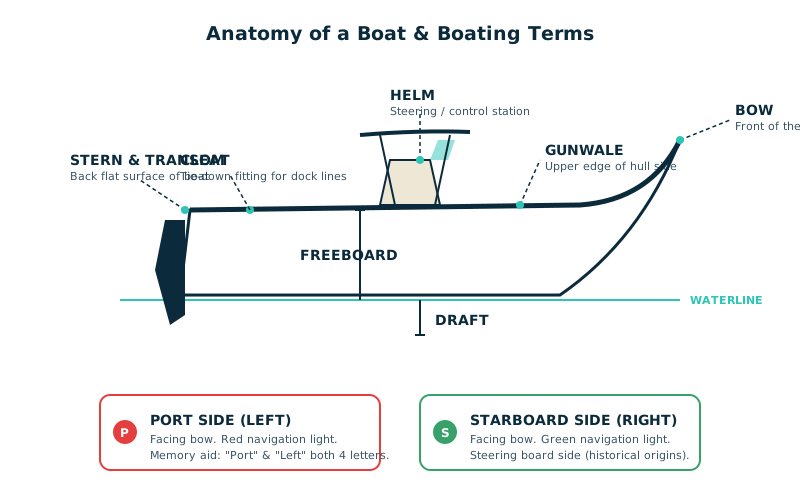
- Port is left and starboard is right when you face the bow.
- Red channel markers stay on your right when returning from sea in U.S. waters.
- Florida-specific terms include ICW, manatee zone and divers-down flag.
- Buying terms such as HIN, title and lien matter before any money changes hands.
Boat parts at a glance
A–B
- Abeam: at a right angle to the side of the boat.
- Aft: toward the stern, or back, of the boat.
- Aids to navigation (ATON): buoys, markers, lights and daybeacons that mark channels and hazards. See Navigation Rules.
- Aground: when the hull is stuck on the bottom. Common on Florida's shallow flats.
- Anchor rode: the line, chain or both that connect the anchor to the boat.
- Astern: behind the boat, or moving backward.
- Beam: the width of the boat at its widest point.
- Bilge: the lowest part of the inside of the hull, where water collects.
- Bilge pump: a pump that removes water from the bilge, often switched on automatically by a float.
- Bill of sale: a written record of a boat sale with buyer, seller, price, date and the boat's description. See Selling a Boat in Florida.
- Bow: the front of the boat.
- Bow line: a docking line tied at the bow.
- Bowrider: an open boat with seating in the bow. See Bowriders.
- Bulkhead: a wall dividing the inside of a hull, or a seawall along a shoreline.
C–D
- Capacity plate: a label near the helm showing the maximum number of people, weight and horsepower the boat is rated for.
- Center console: a boat with the helm in a console in the middle of the deck. See Center Consoles.
- Chart: a map of the water showing depths, hazards, channels and aids to navigation. NOAA publishes official nautical charts.
- Chine: the edge where the bottom of the hull meets the sides.
- Cleat: a deck or dock fitting used to tie off lines.
- Cockpit: the open area of the deck where passengers sit or where you fish.
- Coast Guard Auxiliary: the volunteer arm of the U.S. Coast Guard, which teaches boating courses and offers vessel safety checks.
- Current: the horizontal movement of water, from tides, rivers or ocean flows such as the Gulf Stream.
- Cuddy cabin: a small enclosed cabin in the bow. See Cuddy Cabins.
- Deadrise: the angle of the hull bottom from the keel outward. More deadrise usually means a softer ride in chop.
- Displacement hull: a hull that pushes through the water rather than riding on top of it; efficient at low speed.
- Divers-down flag: a red flag with a white diagonal stripe showing that divers or snorkelers are in the water. Florida law sets distances for boaters; see Diving and Snorkeling.
- Dock lines: lines used to tie a boat to a dock or slip.
- Documentation: federal registration of a vessel with the U.S. Coast Guard, an alternative to state titling for eligible boats.
- Down payment: the part of a purchase price paid up front, with the rest paid over time.
- Draft: the depth of the hull below the waterline; the minimum water you need to float.
- Drift: moving with the wind or current without power or anchor, often used for fishing or drift diving.
E–H
- Ebb tide: a falling tide, when water flows out toward the sea.
- Engine cut-off switch: a lanyard or wireless device that stops the engine if the operator falls away from the helm.
- EPIRB: Emergency Position-Indicating Radio Beacon, a device that sends a distress signal with your position by satellite.
- Fender: a cushion hung over the side to protect the hull from docks and other boats.
- Flats: wide, shallow areas of sand, mud or seagrass, common on Florida's Gulf Coast and in the Keys.
- Float plan: a written trip plan left with someone ashore: who is aboard, where you are going and when you will return.
- Flood tide: a rising tide, when water flows in from the sea.
- Florida boating safety identification card: the card showing you completed an approved boater education course. See Boater Education.
- Florida Keys National Marine Sanctuary: the NOAA-managed marine sanctuary around the Keys, with zones, mooring buoys and rules protecting the reef. See Florida Keys.
- Freeboard: the height of the hull from the waterline to the top of the side.
- Gunwale: the upper edge of the side of the boat, pronounced "gunnel."
- Hatch: an opening in the deck with a cover.
- Head: the toilet on a boat.
- Heading: the direction the boat is pointed.
- Helm: the steering station, including the wheel and controls.
- HIN (Hull Identification Number): a unique 12-character number assigned by the builder and shown on the transom. Check it against the title before you buy.
- Hull: the body of the boat.
I–L
- ICW (Intracoastal Waterway): the protected inland route that runs along Florida's Atlantic and Gulf coasts. See Intracoastal Waterway.
- Idle speed: the slowest speed at which the boat keeps steerage.
- Inboard: an engine mounted inside the hull.
- Inlet: a passage connecting inland waters to the ocean. Florida inlets can be rough when wind opposes the tide.
- Keel: the structural backbone along the bottom of the hull.
- Knot: a speed of one nautical mile per hour.
- Lazarette: a storage compartment in the stern.
- Lee / leeward: the side sheltered from the wind.
- Lien: a legal claim on property, such as a boat, to secure a debt. A lien usually must be released before ownership can transfer cleanly.
- Life jacket (PFD): a personal flotation device. Coast Guard-approved life jackets are required aboard; see Required Safety Equipment.
- Livery: in Florida law, a business that rents boats without providing a licensed captain. See Renting a Boat.
- Lower unit: the underwater part of an outboard or sterndrive that holds the gears and propeller.
M–N
- Manatee zone: an area with seasonal or year-round speed limits to protect manatees, posted with signs. See Environmental Rules.
- Marina: a facility with slips, moorings, fuel and services. See Marinas.
- Marine survey: an inspection of a boat by a marine surveyor, usually before purchase or for insurance.
- Mayday: the spoken distress call for grave and immediate danger, made on VHF channel 16. See Boating Emergencies.
- Mooring: a permanent anchor with a buoy that boats tie to instead of anchoring.
- Mooring buoy: the floating ball of a mooring. In the Keys sanctuary, reef mooring buoys are white with a blue stripe.
- Nautical mile: a distance of about 1.15 statute miles, used for navigation.
- Navigation lights: the red, green and white lights required between sunset and sunrise and in restricted visibility.
- No-wake zone: an area where you must go slow enough to make little or no wake. Florida posts these with regulatory signs.
O–R
- Outboard: an engine mounted on the transom, outside the hull.
- Overboard: off the boat and into the water.
- Pan-pan: the spoken urgency call for a serious situation that is not life-threatening.
- Planing hull: a hull that rises and skims on top of the water at speed.
- Pontoon boat: a flat-deck boat on two or more tubes. See Pontoon Boats.
- Port: the left side of the boat when facing the bow.
- Prop scar: a groove cut in seagrass by a propeller in shallow water. Prohibited in many protected areas.
- Propeller (prop): the spinning blades that drive the boat.
- Registration: the state record and decals that identify a boat. See Boat Registration in Florida.
- Right-of-way: which boat must give way in a meeting, crossing or overtaking situation.
- Rub rail: a protective strip along the outside edge of the hull.
- Rules of the Road: the navigation rules that govern how boats avoid collisions.
S
- Scupper: an opening that drains water off the deck.
- Seacock: a valve on a through-hull fitting that can be closed to stop water entering.
- Securité: the spoken safety call for navigation or weather warnings.
- Slip: a berth at a dock or marina where a boat is kept.
- Small craft advisory: a National Weather Service marine advisory for winds or seas hazardous to small boats. See Florida Marine Weather.
- Sound signals: horn or whistle blasts used to signal intentions and warn other boats.
- Spring line: a dock line run at an angle to stop the boat moving forward or back.
- Starboard: the right side of the boat when facing the bow.
- Stern: the back of the boat.
- Sterndrive: an inboard engine connected to a drive unit outside the transom.
- Survey: see marine survey.
T–Z
- Throwable device: a cushion or ring designed to be thrown to someone in the water.
- Tide: the regular rise and fall of sea level.
- Title: the legal document showing ownership of a boat. Check that the seller's name matches it; see Boat Registration.
- Trailer: the road trailer used to carry a boat. See Trailering a Boat in Florida.
- Transom: the flat back of the hull where outboards are mounted.
- Trim: the angle of the boat or engine relative to the water, adjusted to improve ride and efficiency.
- VHF radio: the marine radio used for calls between boats and to the Coast Guard. Channel 16 is for distress and calling.
- Wake: the waves a moving boat leaves behind. You are responsible for damage your wake causes.
- Waterline: where the water meets the hull.
- Windward: the side facing the wind.
- Wheelhouse: an enclosed helm station.
- Yacht: a loose term for a larger recreational boat, usually with cabins.
Frequently asked questions
What is the difference between port and starboard?
Facing the bow (front) of the boat, port is the left side and starboard is the right side. At night, the port sidelight is red and the starboard sidelight is green.
What does no-wake mean in Florida?
In a no-wake or idle-speed zone, you must operate at the slowest speed that still lets you steer, so the boat makes little or no wake. Florida posts these zones with regulatory signs.
What is a HIN?
The Hull Identification Number is a unique 12-character number assigned to a boat by its builder. It appears on the transom and on title and registration records, and you should check it before buying a used boat.


