
Rules & Safety
Required Boat Safety Equipment in Florida
Life jackets, fire extinguishers, distress signals, sound devices and lights: the equipment Florida and Coast Guard rules require on board, by boat length.
Last reviewed: See official sources

Florida adopts the U.S. Coast Guard's equipment requirements for every boat on state waters and adds a few rules of its own. This page lists what must be on board, organized by item and by boat length, so you can check your boat before an FWC or Coast Guard officer does.
At a glance
- Florida requires owners and operators to carry and maintain the equipment specified in current Coast Guard regulations (s. 327.50 (opens in a new tab)).
- One wearable life jacket per person, plus a throwable device on most boats 16 feet and longer.
- Children under 6 must wear a life jacket on Florida boats under 26 feet while underway.
- Fire extinguishers, ventilation and flame arrestors depend on how the boat is built and fueled.
- Visual distress signals are required on coastal waters, which covers much of Florida's boating.
Life jackets (PFDs)
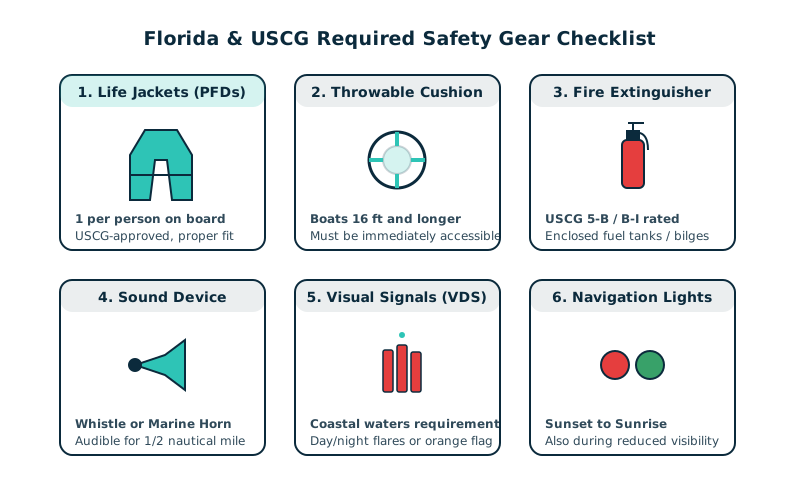
All recreational boats must carry one wearable, Coast Guard–approved life jacket for each person on board. Boats 16 feet and longer, except canoes and kayaks, must also carry one throwable device. Every life jacket must be in good condition, the right size for the wearer, suitable for the activity and readily accessible, not sealed in bags or buried under gear. The throwable should be within arm's reach.
Florida adds wear rules:
- Children under 6 must wear an approved life jacket on vessels under 26 feet while underway.
- Personal watercraft riders, and anyone towed behind one, must wear a non-inflatable approved life jacket.
- Skiers, tubers and other towed riders must wear a non-inflatable approved life jacket.
Inflatable life jackets need a full cylinder and green status indicators to count. Many are not approved for water skiing, tubing or PWC use, so check the label.
Fire extinguishers
Coast Guard–approved, marine-type Class B extinguishers are required when a boat has any of the following: closed compartments where portable fuel tanks may be stored, double bottoms not sealed or filled with flotation, closed living spaces, closed storage for flammable materials, or permanently installed fuel tanks.
| Boat length | Minimum 5-B extinguishers (no fixed system) | With fixed system in machinery space |
|---|---|---|
| Under 26 feet | 1 | 0 |
| 26 to under 40 feet | 2 | 1 |
| 40 up to 65 feet | 3 | 2 |
One 20-B extinguisher may replace two 5-B units. Boats of model year 2018 and newer must carry 5-B or 20-B extinguishers with a date stamp; older boats may keep serviceable B-I or B-II units until they need replacement. Non-rechargeable extinguishers expire 12 years after the date stamped on the bottom. Check seals, gauges and the nozzle before each trip.
Visual distress signals
Boats on U.S. coastal waters, including the waters directly connected to them up to where the waterway narrows to less than two nautical miles, must carry Coast Guard–approved visual distress signals. For Florida boaters that generally means coastal Atlantic and Gulf waters and the larger bays connected to them. If you are unsure whether your waterway counts, carry signals anyway; the Coast Guard recommends them wherever you boat.
- Boats 16 feet and longer: day and night signals.
- Boats under 16 feet, manually propelled boats and open sailboats under 26 feet without an engine: night signals when operating between sunset and sunrise.
Pyrotechnic flares must not be expired (they last 42 months from manufacture), and you need at least three for day and three for night use, or combination flares. Non-pyrotechnic options include an orange distress flag (day) and a certified electronic distress light (night).
Sound, lights and engine safety
Sound devices. Under the Navigation Rules, boats 12 meters (39.4 feet) or longer must carry a whistle, and boats 20 meters or longer also need a bell. Boats under 12 meters must have some other means of making an efficient sound signal, such as a horn or whistle.
Navigation lights. Florida law requires the lights and shapes set by the Navigation Rules. Boats must show them from sunset to sunrise and in restricted visibility. Sirens and flashing or revolving lights are prohibited except as the rules allow. See Navigation Rules for light patterns.
Engine cutoff switch. Operators of boats under 26 feet with an installed cutoff switch must use the link when on plane or above displacement speed. Florida also requires PWC operators to attach the lanyard, and instructors to wear the link when a student is in the water.
Ventilation and backfire flame control. Gasoline-powered boats need ventilation for engine and fuel compartments, and boats with remote-start inboard gasoline engines need a powered blower. Inboard gasoline engines need an approved backfire flame arrestor. Keep ducts clear and blowers working; see Boat Maintenance.
Placards, sanitation and documents
- Oil discharge placard: boats 26 feet and longer with machinery spaces.
- Garbage placard: U.S. boats 26 feet and longer.
- Navigation Rules copy: boats 12 meters and longer on inland waters.
- Toilet: in Florida, boats 26 feet or longer with an enclosed cabin and berths must have a toilet, portable or connected to a certified marine sanitation device (s. 327.53 (opens in a new tab)).
- Registration certificate: must be on board whenever the boat is operated.
- Boater education card and photo ID: for operators who need them; see Boater Education.
Quick check by boat size
- Under 16 feet: wearable life jackets for all, fire extinguisher if required by construction, night distress signals on coastal waters, sound device, lights.
- 16 to under 26 feet: all of the above plus a throwable device and day and night distress signals on coastal waters.
- 26 to under 40 feet: two 5-B extinguishers (or one 20-B), oil and garbage placards, and a toilet if the boat has a cabin with berths.
- 39.4 feet (12 meters) and longer: a whistle and a Navigation Rules copy on inland waters; from 40 feet, three 5-B extinguishers; from 20 meters, a bell as well.
FWC, local and Coast Guard officers can board and check your equipment, and missing or expired items can lead to a citation or civil penalty. More importantly, the equipment is what keeps people alive when something goes wrong.
Get a free check
The Coast Guard Auxiliary and America's Boating Club offer free Vessel Safety Checks. It is not a law enforcement inspection, and examiners will walk through your equipment and explain federal and Florida requirements. For trip-day habits, see Boating Safety and Florida Boating Regulations.
Official sources
Federal carriage rules are in the U.S. Coast Guard's A Boater's Guide to the Federal Requirements for Recreational Boats (opens in a new tab). Florida's additions are in s. 327.50, Florida Statutes (opens in a new tab). Also check FWC Boating Regulations (opens in a new tab).
Frequently asked questions
How many life jackets do I need on my boat in Florida?
One wearable, Coast Guard–approved life jacket of the right size for each person on board. Boats 16 feet and longer, except canoes and kayaks, also need one throwable device.
Do kids have to wear life jackets on a boat in Florida?
Yes. Florida law requires children under 6 to wear an approved life jacket on vessels under 26 feet whenever the boat is underway, meaning not anchored, moored, tied to shore or aground.
Do I need flares on a small boat in Florida?
On coastal waters, boats under 16 feet must carry night visual distress signals when out between sunset and sunrise. Boats 16 feet and longer need both day and night signals on coastal waters.
Is an engine cutoff switch required?
Federal law requires operators of boats under 26 feet with an installed cutoff switch to use the link when on plane or above displacement speed. Florida also requires PWC riders to attach the lanyard.
Official sources
- U.S. Coast Guard — A Boater's Guide to the Federal Requirements for Recreational Boats (opens in a new tab)
- Florida Statutes, s. 327.50 — Vessel safety regulations; equipment and lighting requirements (opens in a new tab)
- Florida Statutes, s. 327.39 — Personal watercraft regulated (opens in a new tab)
- Florida Statutes, s. 327.53 — Marine sanitation (opens in a new tab)
- Florida Statutes, s. 328.48 — Vessel registration (certificate on board) (opens in a new tab)
- USCG Navigation Center — Amalgamated Navigation Rules (Rules 23 and 33) (opens in a new tab)
Checked against these sources on . Rules change — confirm current requirements with the official source before you rely on them.


