
Rules & Safety
Boat Registration and Titling in Florida
Which boats must be registered and titled in Florida, where to apply, what to bring, how to display numbers and decals, and how documented vessels differ.
Last reviewed: See official sources

Florida requires most boats used on its waters to be registered, and most to be titled as well. Both are handled at your county tax collector's office, not through FWC. This page explains which vessels need registration and a title, what to bring, how to display numbers and decals, when to renew, and how federally documented and out-of-state boats are treated, based on Chapter 328 of the Florida Statutes.
At a glance
- Every vessel operated, used or stored on Florida waters must be registered unless an exemption applies.
- Non-motor canoes and kayaks of any length, and other non-motor boats under 16 feet, are exempt.
- Apply at your county tax collector; the registration certificate must be on board when the boat is operated.
- Numbers go on both sides of the bow in block characters at least 3 inches high; the decal goes on the port side.
- Title applications are due within 30 days after a purchase or after Florida becomes the state of principal use.
Which vessels must be registered
Under s. 328.48 (opens in a new tab), each vessel operated, used or stored on the waters of Florida must be registered as a recreational or commercial vessel. Note the word "stored": a boat kept at a dock or on a mooring needs registration even if it rarely moves. The exemptions are narrow:
- A vessel operated, used and stored only on private lakes and ponds
- A vessel owned by the U.S. government
- A vessel used only as a ship's lifeboat
- A non-motor-powered vessel under 16 feet, or a non-motor-powered canoe, kayak, racing shell or rowing scull of any length
Registration is not required for a vessel that is not used on Florida waters. Once you add a motor, even a small electric trolling motor, check with the tax collector, because the non-motor exemption no longer fits.
Titles
Titling proves ownership. Under s. 328.03 (opens in a new tab), each vessel operated, used or stored on Florida waters must be titled by Florida, and the owner must apply within 30 days after a transfer of ownership or after Florida becomes the state of principal use. A late title transfer adds a fee and can bring a penalty.
A title is not required for, among others, documented and foreign-documented vessels, vessels used only on private lakes and ponds, boats held by a dealer for sale, and visiting boats covered by the 90-day rule below. The title stays good for the life of the vessel. If a titled boat is destroyed or abandoned, the owner must surrender the title for cancellation within 30 days.
Buy only with a properly signed title (or a valid exemption) in hand. A seller who cannot produce one may not have clear ownership, and check the title for recorded liens before you pay. See Buying a Used Boat.
How to register: where to go and what to bring
County tax collectors issue registration certificates, numbers and decals as agents of the Department of Highway Safety and Motor Vehicles (s. 328.73 (opens in a new tab)). Many counties offer appointments or online renewals; check your county's tax collector website.
What to bring
- Proof of ownership: a Florida title, an executed bill of sale, a builder's contract, a manufacturer's statement of origin or a federal marine document.
- ID: a valid driver license or ID card from Florida or another state, or a valid passport. Businesses need an FEIN where applicable and proof they may do business in Florida.
- Your physical residential or business address and residency status.
- A complete description of the vessel, including the hull identification number.
- Payment for registration, title and service fees.
Live-aboard owners whose primary residence is the boat may be authorized to use a post office box. A homemade boat registered for the first time gets a certificate without a hull identification number; ask the tax collector what paperwork it needs.
Fees and length classes
Registration fees are set in s. 328.72 (opens in a new tab) by length class, with service fees and county charges added at the counter:
| Class | Length |
|---|---|
| A-1 | Under 12 feet, and any canoe with a motor attached |
| A-2 | 12 feet to under 16 feet |
| 1 | 16 feet to under 26 feet |
| 2 | 26 feet to under 40 feet |
| 3 | 40 feet to under 65 feet |
| 4 | 65 feet to under 110 feet |
| 5 | 110 feet and over |
Boats at least 30 years old, used only for recreation and powered by their original type of engine, may qualify for antique vessel registration. Ask your tax collector for the current total before you go.
Numbers and decals
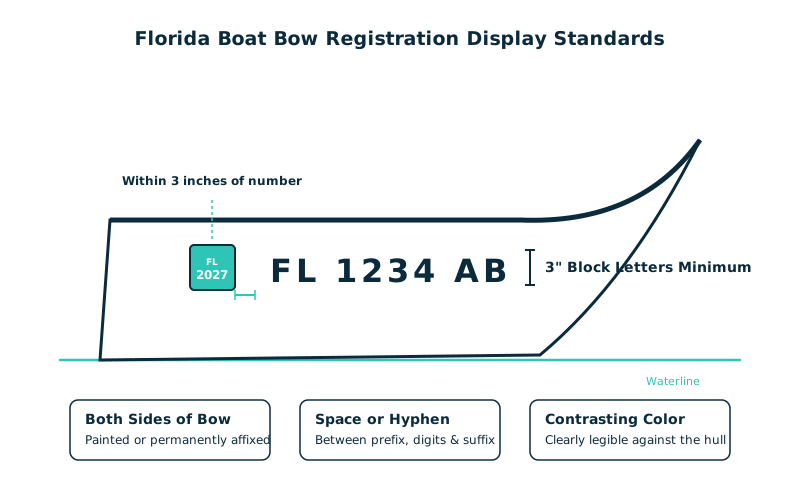
Florida uses the federal numbering pattern (s. 328.54 (opens in a new tab)): "FL," then up to four numbers and two letters, or up to three numbers and three letters, separated by hyphens or equal spaces, for example in the form FL 1234 AB.
Under s. 328.48, the number must be:
- On each side of the forward half of the boat (airboats may use each side of the rudder)
- Read left to right, in block characters of good proportion at least 3 inches high
- A solid color that contrasts with the hull, kept clearly visible and legible
The year decal goes on the port (left) side within 6 inches before or after the number. Remove any old decals. The pocket-size registration certificate must be on board and available for inspection whenever the boat is operated.
A lost decal can be replaced through the tax collector, and a stolen decal is replaced at no charge if you include a copy of the police report. If your address or other registration information changes, update it with the tax collector within 6 months.
Renewals
A registration period is normally 12 months. For boats owned by individuals, it begins on the first day of the owner's birth month, so renewal comes due around your birthday. Individual owners may be eligible for an extended period of about two years; for that option, the renewal window is the 30 days ending on the owner's date of birth. When more than one person is on the registration, the birth month of the first-named owner is used. Your tax collector will tell you the renewal date and the online options for your county.
Documented, out-of-state and visiting boats
Federally documented vessels
Documentation is a federal alternative to a state title, issued by the Coast Guard's National Vessel Documentation Center (opens in a new tab). A vessel of at least five net tons wholly owned by U.S. citizens is eligible, including purely recreational boats (46 CFR 67.5 (opens in a new tab)). Recreational certificates of documentation can be renewed for 1 to 5 years through the NVDC's online storefront.
In Florida, a documented vessel does not need a Florida title or Florida numbers on the hull. Florida law still provides for registering documented vessels: the decal goes on the port side, and may be placed on a port-side window or windshield instead of the hull.
The Coast Guard warns that private companies offering to handle documentation renewals for a fee are not affiliated with it. You can renew directly with the NVDC.
Boats registered in another state
A boat with a valid number from another state's federally approved numbering system may be used in Florida without a Florida number for up to 90 consecutive days (s. 328.56 (opens in a new tab)). After that, the owner must record the number with Florida under s. 328.58 (opens in a new tab). A boat from another country that is temporarily using Florida waters is also exempt from Florida numbering.
Active-duty military personnel stationed in Florida may keep using a valid out-of-state registration until it expires; after that, registration and titling move to Florida (s. 328.60 (opens in a new tab)).
Buying or selling a registered boat
When a registered boat changes hands, the new owner must file for transfer of registration with the county tax collector within 30 days (s. 328.72 (opens in a new tab)), along with the title transfer. Sellers should see Selling a Boat in Florida for the title, bill of sale and payment steps, and buyers should read Buying from a Private Seller. If you are new to the operating rules, continue with Florida Boating Regulations and Boater Education.
Official sources
Read the current law in Chapter 328, Florida Statutes (opens in a new tab), contact your county tax collector for fees and appointments, and check documentation with the U.S. Coast Guard National Vessel Documentation Center (opens in a new tab).
Frequently asked questions
Do I need to register a kayak or paddleboard in Florida?
Not if it has no motor. Florida exempts non-motor-powered canoes, kayaks, racing shells and rowing sculls of any length, and other non-motor vessels under 16 feet. Adding a motor brings the vessel under the registration law.
Where do I register a boat in Florida?
At your county tax collector's office, which issues registration certificates, numbers and decals as an agent of the Department of Highway Safety and Motor Vehicles.
How long can I use my out-of-state registration in Florida?
A boat with a valid number from another state's federally approved system can be used in Florida for up to 90 consecutive days. After that, the number must be recorded with Florida.
Does a federally documented boat need Florida registration?
Documented vessels do not need a Florida title or Florida numbers on the hull, but Florida law still provides for registering them and displaying the decal on the port side.
Official sources
- Florida Statutes, s. 328.48 — Vessel registration, application, certificate, number, decal (opens in a new tab)
- Florida Statutes, s. 328.56 — Vessel registration number (opens in a new tab)
- Florida Statutes, s. 328.54 — Federal numbering system adopted (opens in a new tab)
- Florida Statutes, s. 328.03 — Certificate of title required (opens in a new tab)
- Florida Statutes, s. 328.72 — Classification; registration; fees and charges (opens in a new tab)
- Florida Statutes, s. 328.73 — Registration; duties of tax collectors (opens in a new tab)
- Florida Statutes, s. 328.58 — Reciprocity of nonresident or alien vessels (opens in a new tab)
- Florida Statutes, s. 328.60 — Military personnel; registration (opens in a new tab)
- U.S. Coast Guard — National Vessel Documentation Center (opens in a new tab)
- 46 CFR 67.5 — Vessels eligible for documentation (opens in a new tab)
Checked against these sources on . Rules change — confirm current requirements with the official source before you rely on them.


