
Buying a Boat
Boat Financing: How Boat Loans Work
How boat financing works in Florida: boat loans vs. personal and home equity loans, dealer vs. outside lenders, pre-qualification, refinancing and documents.

Most people who finance a boat use a loan secured by the boat itself. This guide explains how boat financing generally works, how a boat loan compares with other ways to borrow, and how the process can differ for a new boat, a used boat or a purchase from a private seller in Florida, so you know what to prepare before you apply.
At a glance
- Many boat loans are secured by the boat, with a lien recorded on the title
- Personal loans and home equity borrowing work differently and carry different risks
- Lenders typically review credit, income, debts, down payment and the boat itself
- Dealer-arranged financing and outside lenders can both be compared in writing
- A longer term generally lowers the payment but raises total interest
- Estimate scenarios first with the Boat Loan Calculator
How a boat loan works
A boat loan is an installment loan: you borrow part of the purchase price and repay it, with interest, over a set number of months. With a secured boat loan, the boat is the collateral. In Florida, the lender is typically recorded as a lienholder on the vessel title until the loan is paid off, and then the lien is released. Larger boats documented with the U.S. Coast Guard work differently; see Boat Registration in Florida for how titling and documentation differ.
The amount you finance is generally the purchase price, plus any taxes, fees or add-ons you choose to finance, minus your down payment and any trade-in credit. Every dollar financed accrues interest, so what you include in the loan affects the total you pay.
Down payments
A down payment reduces the amount you finance, which lowers both the payment and the total interest. It can also help when a lender weighs the loan amount against the boat's value. How much a lender expects varies by lender, boat and borrower.
Keep enough cash after the down payment for the costs that start right away in Florida: insurance, storage or a slip, registration, safety equipment and early maintenance. Boat Ownership Cost outlines the main drivers.
Loan terms and the payment trade-off
The loan term is how long you take to repay. The trade-off is consistent:
- Longer term: lower monthly payment, more total interest over the life of the loan.
- Shorter term: higher monthly payment, less total interest.
Available terms depend on the lender, the loan amount and the boat. Before you choose, compare both the monthly payment and the total cost. The Boat Loan Calculator shows how changing the term, down payment or price moves each number.
Fixed vs. variable rates
With a fixed rate, the interest rate stays the same for the life of the loan, so the payment is predictable. With a variable rate, the rate is tied to an index and can rise or fall over time, which means your payment or total interest can change. If a lender offers a variable rate, ask in writing how often it can change, what it is tied to and whether there are limits on how far it can move. Only you can judge how much payment uncertainty fits your budget.
Boat loan vs. personal loan vs. home equity
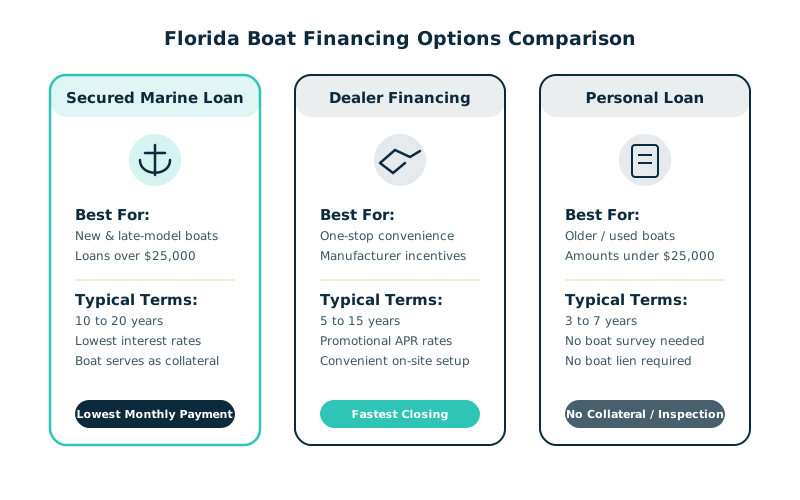
A boat loan is not the only way to borrow for a boat. The main differences are what secures the debt and what you could lose if you can't repay.
| Secured boat loan | Unsecured personal loan | Home equity loan or line of credit | |
|---|---|---|---|
| Collateral | The boat | None | Your home |
| Lien on the boat's title | Yes, until the loan is paid off | No | No; the lien is on your home |
| Relative term length | Often longer than a personal loan | Often shorter | Varies by product; can be long |
| If you can't repay | The lender may repossess the boat | No collateral to take, but default harms your credit and can lead to collection | Your home is at risk |
| Funding speed | Depends on boat and title checks; private sales can take longer | Often relatively quick | Often slower; may involve a home appraisal and closing |
| How funds can be used | Tied to the boat being purchased | Generally flexible | Generally flexible |
Each option is priced and reviewed differently, and lenders set their own criteria. Putting your home up as collateral for a recreational purchase is a significant decision, so weigh that risk carefully and read every disclosure before you sign.
What lenders typically look at
Each lender sets its own criteria, but most look at a similar set of factors:
| Factor | What it generally tells the lender |
|---|---|
| Credit history | How you have managed past and current debts |
| Income and debt-to-income (DTI) | Whether a new payment fits alongside your existing obligations |
| Down payment | How much of your own money is in the purchase |
| Boat age, type and value | The collateral behind the loan and how it may hold value |
| Purchase type | New from a dealer, used from a dealer or a private-party sale |
No single factor decides an application. Lenders weigh them together, and requirements, terms and program availability differ from lender to lender.
Documents to prepare
Having documents ready can make the process smoother. Lenders may ask for different items, but these are common:
Commonly requested documents
- Government-issued photo ID
- Proof of income, such as pay stubs, tax returns or bank statements
- Information about current debts and housing costs
- Purchase agreement or buyer's order
- Boat details: year, make, model, length, engine and HIN
- For used or private-party boats: title copy, lien release if applicable and, if requested, a marine survey
- Proof of insurance before closing
Pre-qualification vs. pre-approval
Lenders use these words in different ways. In general, a pre-qualification is an early estimate of what a lender may be willing to lend, often based on information you report yourself. A pre-approval usually involves the lender reviewing verified information, such as your credit report and income documents. The Consumer Financial Protection Bureau (opens in a new tab) notes that lenders' processes vary widely and that neither letter is a guaranteed loan offer.
What matters is what the lender actually reviewed and what conditions still apply. Ask whether a credit check is involved, how long any letter or estimate stays valid, and what could change the final terms, such as the boat's value, a survey or the title. Final terms come only after a full application and the lender's review of the specific boat.
New, used and private-party purchases
New boats
New boats from a dealer are usually the most straightforward to finance. The dealer provides the paperwork, the value is clear, and the title is new.
Used boats
For used boats, lenders often pay closer attention to the boat's age, condition and value. Some may ask for a marine survey, especially on larger or older boats. Buying a Used Boat explains inspections and surveys.
Private-party purchases
When you buy from an individual owner, there is no dealer handling the paperwork. Lenders that finance private sales usually verify the title, lien status and hull identification number themselves, and they may pay the seller, or the seller's lender, directly at closing. This can take longer, so plan your timeline. Buying From a Private Seller explains the checks involved.
Dealer financing vs. an outside lender
Many dealers can arrange financing through lenders they work with. This is convenient because the purchase and the loan paperwork happen in one place, and the dealer may be paid for arranging it. You can also apply with an outside lender, such as a bank, credit union or specialty marine lender, and arrive at the dealership with financing already in progress.
Neither route is automatically better. To compare fairly:
- Get the terms from each source in writing: amount financed, rate, term, fees and total cost.
- Negotiate the boat's price, your trade-in and any add-ons separately from the financing, so one does not hide changes in another.
- Check which extras, such as extended service contracts or protection products, are being added to the amount financed, and whether they are optional.
- Do not sign until every number on the contract matches what you were told.
Buying From a Dealer covers the rest of the dealer process.
Refinancing a boat loan
Refinancing means replacing your current boat loan with a new one, usually from a different lender. It may be worth looking into when market rates have changed since you borrowed, when your credit has improved, or when you want to move from a variable rate to a fixed rate.
Before you refinance, check the full cost, not only the new payment:
Costs and details to check before refinancing
- Any prepayment penalty on your current loan
- Application, origination or other fees on the new loan
- Title and lien fees to record the new lender and release the old lien on your Florida title
- How the new term affects total interest; stretching the term can lower the payment but raise the total you pay
- Whether the boat's current value supports the balance you want to refinance
Run your current loan and the proposed one through the Boat Loan Calculator to compare total cost side by side.
The financing process, step by step
- Set a budget that includes ownership costs, not only the payment.
- Estimate scenarios with the Boat Loan Calculator.
- Gather documents from the checklist above.
- Apply and answer any follow-up questions from the lender.
- Review the terms in writing, including the amount financed, term and total cost.
- Close by signing the loan documents. The lender pays the seller, and the lien is recorded on the title.
- Insure, title and register the boat. Florida titles and registrations are handled through the Florida Department of Highway Safety and Motor Vehicles (opens in a new tab), usually at a county tax collector's office.
About applying through this site
Florida Boating Info is an information site. It does not lend money, make credit decisions or set rates or terms. When you choose to apply, the application is completed through Vantage Recreational Finance, and any terms come from the lender based on its own review. Florida Boating Info may be compensated when visitors apply.
Frequently asked questions
Is a boat loan secured?
Many boat loans are secured by the boat itself, which means the lender has a lien on the title until the loan is paid off. Unsecured personal loans are another option some buyers consider, and they work differently.
Does a longer loan term save money?
A longer term usually lowers the monthly payment but increases the total interest paid over the life of the loan. A shorter term does the opposite. The Boat Loan Calculator shows the trade-off for your own numbers.
Can I finance a used boat or a private-party purchase?
Many lenders finance used boats and some finance private-party sales, but they may look more closely at the boat's age, condition, value and title. Requirements vary by lender and program.
How are larger documented boats financed?
Larger boats documented with the U.S. Coast Guard instead of titled in Florida are often financed with a marine mortgage. When it meets federal requirements and is recorded with the Coast Guard's National Vessel Documentation Center, it is called a preferred ship mortgage and takes the place of a lien on a state title. Not every lender offers these loans, and requirements vary.
Does Florida Boating Info make loans?
No. Florida Boating Info is an information site. It does not lend, make credit decisions or set terms. Applications are completed through Vantage Recreational Finance.


