
Rules & Safety
Florida Boating Regulations
Florida boating laws explained: registration and titling, who may operate, BUI, careless operation, PWC and towing rules, diver flags and accident reporting.
Last reviewed: See official sources

Florida boating law is mostly found in Chapters 327 and 328 of the Florida Statutes, enforced by the Florida Fish and Wildlife Conservation Commission (FWC), county sheriffs and local police. This page summarizes the rules that most often apply to recreational boaters, with links to the exact statute so you can read the current wording yourself.
At a glance
- Motorized boats used on Florida waters must be registered, and most must also be titled within 30 days of purchase.
- Operators born on or after January 1, 1988, need boater education credentials for motors of 10 hp or more.
- Boating under the influence starts at 0.08 blood- or breath-alcohol, or any level that impairs your normal faculties.
- Nobody under 14 may operate a personal watercraft.
- Accidents with injury, death, a missing person or at least $2,000 in damage must be reported.
Registration, numbers and titles
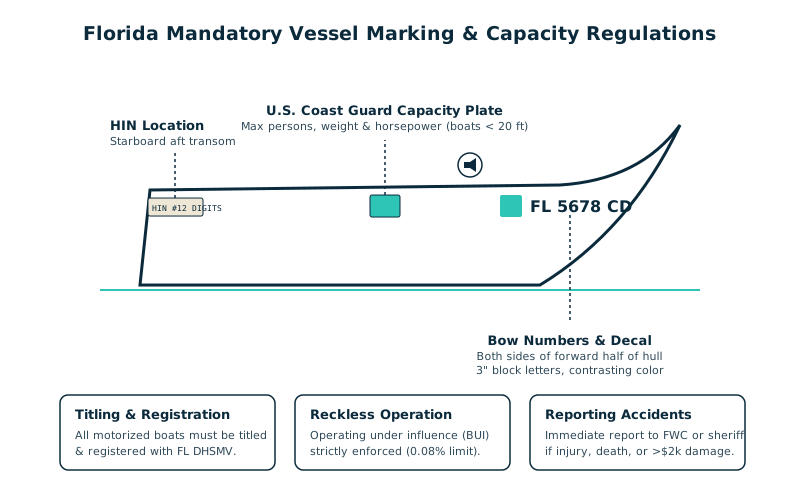
Under s. 328.48 (opens in a new tab), every vessel operated, used or stored on Florida waters must be registered, unless it is one of these:
- A vessel used only on private lakes and ponds
- A vessel owned by the U.S. government
- A ship's lifeboat
- A non-motor-powered vessel under 16 feet, or a non-motor canoe, kayak, racing shell or rowing scull of any length
You apply through your county tax collector. The registration number must be on each side of the forward half of the boat in block characters at least 3 inches high, in a color that contrasts with the hull. The year decal goes on the port (left) side within 6 inches of the number, and the pocket-size registration certificate must be on board whenever the boat is operated. If your registration details change, update them with the tax collector within 6 months.
Titling is a separate step. Section 328.03 (opens in a new tab) requires most vessels to be titled within 30 days after a transfer of ownership or after Florida becomes the state of principal use, with exemptions such as federally documented vessels. Fees depend on vessel length and county; check the FLHSMV vessel page (opens in a new tab). If you are buying, our used boat guide covers the paperwork side, and Boat Registration and Titling walks through the process step by step.
Who may operate a boat
Florida has no boat driver's license, but boater education is required for many operators. Anyone born on or after January 1, 1988, must carry a boating safety education ID card (or an accepted equivalent) and photo ID to operate a vessel powered by a motor of 10 horsepower or more, unless an exemption applies.
Personal watercraft have extra limits under s. 327.39 (opens in a new tab):
- No one under 14 may operate a PWC, and owners may not knowingly let them.
- Everyone riding or being towed must wear a non-inflatable, Coast Guard–approved life jacket.
- If the PWC has a lanyard engine cutoff switch, the operator must attach it.
- No PWC operation from one-half hour after sunset to one-half hour before sunrise.
- Weaving through congested traffic, jumping another boat's wake too closely, or swerving at the last moment counts as reckless operation.
Careless, reckless and impaired operation
Section 327.33 (opens in a new tab) requires you to operate in a reasonable and prudent manner, considering other traffic, posted speed and wake restrictions, and conditions. Failing to do so is careless operation. Willful or wanton disregard for safety is reckless operation, a criminal offense whose level rises if someone is hurt. The same section requires every operator to follow the Navigation Rules.
Under s. 327.35 (opens in a new tab), you are boating under the influence (BUI) if alcohol or drugs impair your normal faculties, or if your blood- or breath-alcohol level is 0.08 or higher.
A first BUI conviction in Florida carries a fine of $500 to $1,000 and up to 6 months in jail, and penalties increase sharply for repeat offenses or when someone is injured or killed. Appoint a sober operator before you leave the dock.
Towing, divers and posted zones
Water sports. When towing a skier or tuber, s. 327.37 (opens in a new tab) requires an observer on board in addition to the operator, or a wide-angle rearview mirror. Parasailing always needs an observer. Towed riders must wear a non-inflatable approved life jacket, and towing is not allowed from one-half hour after sunset to one-half hour before sunrise.
Divers-down flags. Under s. 327.331 (opens in a new tab), make a reasonable effort to stay at least 100 feet from a divers-down flag or buoy on rivers, inlets and navigation channels, and at least 300 feet in other waters. Inside those distances, go no faster than needed to keep headway and steerage.
Speed and wake zones. Section 327.46 (opens in a new tab) lets FWC and local governments create boating-restricted areas, such as idle-speed or slow-speed zones near boat ramps, fuel docks, bridges and locks, and vessel-exclusion swim areas. Exact limits differ by location, so obey the posted signs. Manatee zones are covered in Environmental Rules.
Noise. Engine exhaust must be effectively muffled; cutouts are prohibited except in races. Some counties adopt an additional sound limit under s. 327.65 (opens in a new tab).
Accidents and reporting
If you are involved in a collision or other casualty, s. 327.30 (opens in a new tab) requires you to give practical assistance where you can do so safely and to give your name, address and vessel identification in writing to anyone injured and to owners of damaged property.
You must notify FWC's Division of Law Enforcement, the county sheriff or the municipal police without delay when an accident involves capsizing, collision, sinking, injury needing treatment beyond first aid, death, a person disappearing, or damage of at least $2,000. Section 327.301 (opens in a new tab) adds a written report requirement unless an investigating officer files one. Boating Emergencies and the Coast Guard covers what to do on the water before the paperwork.
Leaving the scene of a boating accident without giving aid and notifying law enforcement is a crime in Florida, with penalties that increase if anyone is injured or killed.
Equipment and safety rules
State law adopts the Coast Guard's equipment requirements and adds Florida-specific rules, such as life jackets for children under 6 on boats under 26 feet. See Required Safety Equipment for the full checklist and Boating Safety for trip planning. Before each trip, check conditions with our Florida Marine Weather guide.
Official sources
Read the current text of Chapter 327 (opens in a new tab) and Chapter 328 (opens in a new tab) of the Florida Statutes, and check FWC Boating Regulations (opens in a new tab) for rules, local zones and enforcement updates.
Frequently asked questions
Does my kayak or canoe need to be registered in Florida?
Not if it has no motor. Florida law exempts non-motor-powered canoes, kayaks, racing shells and rowing sculls of any length, and other non-motor vessels under 16 feet. Add a motor and registration is required.
What is the blood-alcohol limit for boating in Florida?
Florida law treats a blood- or breath-alcohol level of 0.08 or more as boating under the influence. You can also be charged below that level if your normal faculties are impaired.
How old do you have to be to drive a jet ski in Florida?
Florida law says no one under 14 may operate a personal watercraft. Operators born on or after January 1, 1988, also need boater education credentials for a motor of 10 horsepower or more.
Do I have to report a boating accident in Florida?
Yes, when it involves things like injury beyond first aid, death, a missing person, or damage of at least $2,000. Notify FWC, the county sheriff or the local police without delay, and file a written report when required.
Official sources
- Florida Statutes, s. 328.48 — Vessel registration, application, certificate, number, decal (opens in a new tab)
- Florida Statutes, s. 328.03 — Certificate of title required (opens in a new tab)
- Florida Statutes, s. 327.33 — Reckless or careless operation of vessel (opens in a new tab)
- Florida Statutes, s. 327.35 — Boating under the influence (opens in a new tab)
- Florida Statutes, s. 327.39 — Personal watercraft regulated (opens in a new tab)
- Florida Statutes, s. 327.37 — Water skis, parasails, aquaplanes regulated (opens in a new tab)
- Florida Statutes, s. 327.331 — Divers-down warning device (opens in a new tab)
- Florida Statutes, s. 327.46 — Boating-restricted areas (opens in a new tab)
- Florida Statutes, s. 327.30 — Collisions, accidents, and casualties (opens in a new tab)
- Florida Statutes, s. 327.301 — Written reports of accidents (opens in a new tab)
- Florida Statutes, s. 327.65 — Muffling devices (opens in a new tab)
- Florida Fish and Wildlife Conservation Commission — Boating Regulations (opens in a new tab)
- FLHSMV — Vessel Titling and Registrations (opens in a new tab)
Checked against these sources on . Rules change — confirm current requirements with the official source before you rely on them.


