
Rules & Safety
Navigation Rules for Florida Boaters
The rules of the road on Florida waters: lookout and safe speed, meeting, crossing and overtaking, who gives way, sound signals, lights and channel markers.
Last reviewed: See official sources

The Navigation Rules, often called the rules of the road, decide who gives way, how fast you may go and what lights and sounds you must use. They are federal rules, and Florida law requires every operator on state waters to follow them. This page covers the rules a recreational boater uses most in Florida, from crowded inlets to the Intracoastal Waterway.
At a glance
- Florida's s. 327.33 (opens in a new tab) requires all operators to comply with the Navigation Rules, and fault in accidents is judged by them.
- Always keep a proper lookout and travel at a safe speed.
- Meeting head-on: both power-driven boats turn to starboard.
- Crossing: the boat with the other on its starboard side gives way.
- Overtaking: the passing boat keeps clear.
Lookout, safe speed and responsibility
Rule 5 requires every vessel to keep a proper lookout at all times, by sight and hearing and by every available means. Rule 6 requires a safe speed, one that lets you take effective action and stop in time for the conditions. Visibility, traffic density, your boat's stopping distance, background lights at night, wind, waves and current all matter.
Rule 2 adds that nothing in the rules excuses you from ordinary good seamanship. Having the right of way does not entitle you to hit anyone. If a collision is about to happen, every vessel must act to avoid it.
Meeting, crossing and overtaking
When two boats meet, one is usually the give-way vessel and the other the stand-on vessel. The give-way boat must take early and substantial action to keep well clear. The stand-on boat keeps its course and speed, but must act if it becomes clear the other boat is not doing enough.
| Situation | What the rules say |
|---|---|
| Head-on (power-driven boats) | Each alters course to starboard and passes port to port (Rule 14). |
| Crossing (power-driven boats) | The boat that has the other on its own starboard side gives way and, if possible, avoids crossing ahead (Rule 15). |
| Overtaking | The overtaking boat keeps out of the way of the boat being passed, until finally past and clear (Rule 13). |
| Narrow channel | Keep as near to the starboard (right) edge of the channel as is safe and practicable (Rule 9). |
If you are not sure whether you are overtaking or in a head-on situation, the rules say to assume you are and act accordingly.
Who gives way to whom
Rule 18 sets an order of responsibility. A power-driven vessel underway must keep out of the way of a vessel not under command, a vessel restricted in its ability to maneuver, a vessel engaged in fishing (using nets, lines or other gear that restrict its maneuverability, which does not include trolling) and a sailing vessel. A sailboat under engine power counts as a power-driven vessel. In Florida's channels and inlets, give large commercial ships, tugs and barges plenty of room; they cannot stop or turn quickly.
Sound signals
The rules differ slightly between inland waters and international waters; the dividing lines are shown on nautical charts. On inland waters, power-driven boats in sight of each other and meeting or crossing within half a mile use whistle signals to state their intentions (Rule 34):
- One short blast: I intend to leave you on my port side.
- Two short blasts: I intend to leave you on my starboard side.
- Three short blasts: I am operating astern propulsion.
- Five or more short, rapid blasts: doubt or danger.
- One prolonged blast: approaching a bend or blind spot in a channel.
On inland waters these are signals of intent, and the other boat answers with the same signal if it agrees. On international waters offshore they signal an action already being taken. Boats 12 meters (39.4 feet) or longer must carry a whistle; smaller boats need some other means of making an efficient sound signal. See Required Safety Equipment.
Lights at night and in poor visibility
Florida law requires boats to carry the lights the Navigation Rules specify (s. 327.50 (opens in a new tab)). Lights must be shown from sunset to sunrise and in restricted visibility such as heavy rain or fog.
- A power-driven vessel shows red and green sidelights, a white masthead light and a white sternlight.
- A power-driven vessel under 12 meters may instead show sidelights and one all-round white light.
- Sailing vessels and boats under oars have their own light patterns.
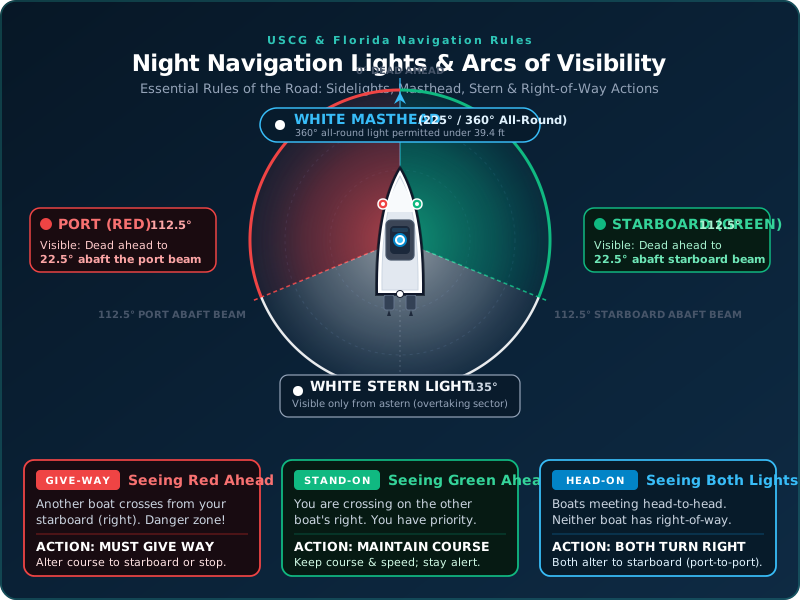
Reading another boat's lights tells you which way it is heading: if you see its red sidelight, you are looking at its port side. Sirens and flashing or revolving lights are prohibited on recreational boats in Florida except as the rules allow.
Aids to navigation in Florida
Buoys and beacons mark safe water and hazards. U.S. lateral markers follow red, right, returning: when returning from seaward, keep red markers on your starboard side and green on your port side. Do not rely on buoys alone, because storms and waves can move them, and always carry a current chart. See Maps & Routes for chart resources.
Orange-and-white information and regulatory markers are maintained by the states, not the Coast Guard. In Florida they often mark idle-speed, slow-speed and manatee zones, and the speed rules on them are enforceable. See Environmental Rules and Florida Boating Regulations.
Divers-down flags are not Navigation Rules markers, but Florida law requires you to keep clear and slow down near them (s. 327.331 (opens in a new tab)).
In Florida, breaking the Navigation Rules is a noncriminal violation on its own, but it becomes a misdemeanor if it causes a boating accident with serious bodily injury or death, and reckless operation can bring felony charges.
Boating at night in Florida
Night boating changes how you see the water. Distances are harder to judge, shorelines blend into city lights, and a boat without proper lights can be invisible until it is very close. Rule 6 counts background lights as a factor in safe speed, which matters along Florida's lit waterfronts.
Lights and markers
Your boat must show the navigation lights described above from sunset to sunrise; check that they work before you leave. See Required Safety Equipment. Many markers are lit, but many day beacons and small channel markers are not, and in Florida's backcountry, rivers and bays you may be relying on a spotlight and your chart. Use the spotlight briefly to find a marker, not to sweep other boats, because it destroys their night vision.
Speed zones still apply
Darkness does not suspend posted speed zones, including manatee zones. Some zones apply only during stated hours or seasons, so follow exactly what the sign says. Read the signs during daylight on familiar routes, mark zones on your chart, and slow down well before the area you know they start. See Environmental Rules.
Anchored boats and sandbars
After dark, boats left at a sandbar or anchorage must show an all-round white anchor light, with limited exceptions for small boats away from channels and areas where boats normally navigate (Rule 30). Expect unlit or poorly lit anchored boats near popular sandbars and slow down when approaching them. Our Anchoring and Docking page covers anchor lights in more detail.
Before a night run
- Navigation lights and anchor light tested
- Working spotlight or handheld light, plus spare batteries
- Route planned on a chart, with unlit markers and speed zones noted
- Chartplotter dimmed to night mode to protect your vision
- Life jackets easy to reach, and a float plan left with someone ashore
- A sober operator and an extra lookout
Keep a copy on board
Boats 12 meters or longer must carry a copy of the Navigation Rules on inland waters; the Coast Guard's amalgamated version qualifies. For smaller boats it is still a good reference, and Boater Education courses cover these rules in more depth. Good manners on the water are covered in Boating Etiquette.
Official source
Read the full text of the Amalgamated International and U.S. Inland Navigation Rules (opens in a new tab) from the U.S. Coast Guard Navigation Center.
Frequently asked questions
Who has the right of way when two powerboats cross?
The boat that has the other on its own starboard (right) side must keep out of the way and, if possible, avoid crossing ahead. The other boat should hold course and speed, but must act to avoid a collision if the give-way boat does not.
What does red, right, returning mean?
When returning from seaward, keep red lateral markers on your right (starboard) side. Green markers are then on your left.
What does five short blasts mean?
Five or more short, rapid blasts signal doubt or danger: the boat sounding it does not understand your intentions or thinks you are not doing enough to avoid a collision.
Are the Navigation Rules law in Florida?
Yes. Florida law requires every operator on state waters to comply with the Navigation Rules, and violations can bring a citation or criminal charges if they cause serious injury or death.
Official sources
- USCG Navigation Center — Amalgamated International and U.S. Inland Navigation Rules (opens in a new tab)
- U.S. Coast Guard — A Boater's Guide to the Federal Requirements for Recreational Boats (opens in a new tab)
- Florida Statutes, s. 327.33 — Reckless or careless operation of vessel (compliance with navigation rules) (opens in a new tab)
- Florida Statutes, s. 327.50 — Equipment and lighting requirements (opens in a new tab)
- Florida Statutes, s. 327.331 — Divers-down warning device (opens in a new tab)
Checked against these sources on . Rules change — confirm current requirements with the official source before you rely on them.


