
Rules & Safety
Florida Boater Education
Who needs a Florida boating safety education ID card, what to carry on board, how to get the card or a temporary certificate, and who is exempt.
Last reviewed: See official sources

Florida does not issue a boat driver's license, but many operators must complete boater education and carry proof of it on board. This page explains who needs the Florida boating safety education ID card, what counts as proof, how to get the card or a temporary certificate, and who is exempt, based on s. 327.395 of the Florida Statutes (opens in a new tab).
At a glance
- Required for anyone born on or after January 1, 1988, operating a vessel with a motor of 10 horsepower or more.
- Carry the card (or an accepted equivalent) plus photo ID whenever you operate.
- The card from an approved course is valid for life.
- A temporary certificate from the FWC exam is valid for 90 days.
- Courses must meet NASBLA standards and be approved by FWC.
Who needs boater education in Florida
The rule is based on your date of birth and the size of the motor, not the size of the boat. If you were born on or after January 1, 1988, you may not operate a vessel powered by a motor of 10 horsepower or more unless you have the required documents on board. That includes most outboard-powered skiffs, personal watercraft and pontoon boats.
If you were born before 1988, the card is not legally required. A course is still a practical way to learn Florida's rules and the hazards covered below.
What you must carry on board
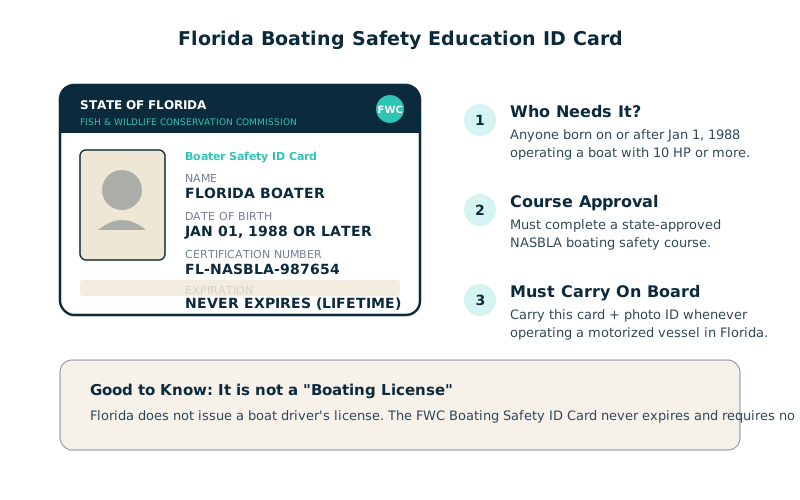
While operating, a person covered by the rule must have one of the following with them:
- Photo ID and a Florida boating safety identification card issued by FWC
- A state-issued ID card or driver license that shows you hold the Florida boating safety card
- Photo ID and a temporary certificate issued or approved by FWC
- Photo ID and an International Certificate of Competency, a boating safety card or certificate from another state or U.S. territory, or a Canadian Pleasure Craft Operator Card
FWC may issue the card and the temporary certificate in digital, electronic or paper format.
How to get the card or a temporary certificate
Take an approved course
Complete a boating safety education course approved by FWC that meets the minimum standards of the National Association of State Boating Law Administrators (NASBLA). FWC lists approved classroom and online options on its Boating Safety Courses (opens in a new tab) page. Online providers must be FWC-approved before they offer courses to the public.
Once you pass, you receive the Florida boating safety education ID card, which is valid for life. For up to 90 days after passing, you may operate using a boating safety education certificate from the course plus photo ID while you wait for the card.
Pass the temporary certificate exam
If you need to operate soon and do not have a card, you can pass a temporary certificate examination developed or approved by FWC. The temporary certificate is valid for 90 days from the date it is issued. It can be a practical option for visitors who will only boat in Florida for a short stay.
What the course covers
Florida law requires approved courses and exams to include, among other topics:
- Divers in the water, divers-down flags and the distance rules
- Passengers riding on gunwales, the bow, seat backs or other areas not designed for seating
- People falling overboard and operating near people in the water
- Starting the engine in gear and leaving it running while people board
- The proper use of an engine cutoff switch
Fees
The statute allows FWC to collect a $2 fee for each card and temporary certificate. Course providers and exam agents may charge their own service fees, so the total cost depends on the provider you choose. Check current costs with the provider before you enroll.
Before you take the helm
- Check your birth year and the horsepower of the motor.
- Complete an FWC-approved course or pass the temporary certificate exam.
- Keep the card or certificate with your photo ID on the boat.
- If you just bought the boat, keep the bill of sale on board.
Exemptions
You do not need to meet the requirement if you:
- Hold a U.S. Coast Guard master's license, or held one before and request a card from FWC with proof
- Operate only on a private lake or pond
- Are accompanied by someone 18 or older who holds a card or is exempt, and who is attending to the operation of the boat and responsible for it
- Are a nonresident with photo ID and proof of a course or equivalency exam from another state or U.S. territory that meets NASBLA standards
- Are operating within 90 days after buying the vessel and have a qualifying bill of sale on board
- Are within 90 days after completing a course and carry photo ID and the course certificate
- Are exempted by an FWC rule
Exemptions are narrow. If you are relying on one, carry the documents that prove it.
Penalties and mandatory education
Operating without the required documents is a noncriminal infraction under Florida law. FWC also runs a mandatory boating education (opens in a new tab) program that can apply to operators after certain violations or infractions, regardless of age. Requirements and deadlines are set by FWC, so read its page if you receive a citation.
A boat rental or a friend's boat does not change the rule. If you were born on or after January 1, 1988, and the motor is 10 hp or more, you need valid credentials or a qualifying exemption before you take the helm.
Keep learning after the course
The U.S. Coast Guard recommends formal instruction and on-water skills training, noting that most fatal boating incidents involve operators with no formal instruction. After your course, review Boating Safety, the Navigation Rules and the rest of Florida Boating Regulations.
Official source
Find approved courses and card information at FWC — How to Get a Boater Education Identification Card (opens in a new tab), and read the current law in s. 327.395, Florida Statutes (opens in a new tab).
Frequently asked questions
Does the Florida boating safety education ID card expire?
No. Under Florida law, a card issued after completing an approved course is valid for life. A temporary certificate from passing the temporary certificate exam is valid for 90 days.
I was born before 1988. Do I need the card?
Florida law does not require it for you. The requirement applies to people born on or after January 1, 1988. A course is still a good way to learn Florida's rules.
Is my boating card from another state valid in Florida?
Florida accepts boating safety cards or certificates from other states and U.S. territories, the Canadian Pleasure Craft Operator Card and an International Certificate of Competency, when carried with photo ID and the course meets NASBLA standards.
Can someone without a card drive if I am on board?
Yes, if you are 18 or older, you hold a card or are exempt yourself, and you are attending to the operation of the boat. You are then responsible for its safe operation and for any violation.
Official sources
- Florida Statutes, s. 327.395 — Boating safety education (opens in a new tab)
- FWC — How to Get a Boater Education Identification Card (opens in a new tab)
- FWC — Boating Safety Courses (opens in a new tab)
- FWC — Mandatory Boating Education (opens in a new tab)
- U.S. Coast Guard — A Boater's Guide to the Federal Requirements for Recreational Boats (opens in a new tab)
Checked against these sources on . Rules change — confirm current requirements with the official source before you rely on them.


